Start at 1.5 Inches Compacted
For conventional overlay work, 1.5 inches (38mm) compacted is the practical minimum. Anything thinner is a thin-lift overlay and should only be considered when the existing pavement is already structurally sound.
If you're planning to resurface a driveway or parking lot in Scottsdale, Scottsdale Asphalt specifies overlay thickness by existing pavement condition, traffic load, and desert-climate stress instead of using one blanket number. The practical answer usually starts at 1.5 inches compacted for a conventional overlay, then increases when the base, drainage, or traffic load demands more.
For conventional overlay work, 1.5 inches (38mm) compacted is the practical minimum. Anything thinner is a thin-lift overlay and should only be considered when the existing pavement is already structurally sound.
Passenger-car driveways often perform with 1.5 to 2 inches, RV or boat driveways may call for 2 to 2.5 inches, and commercial drive lanes often move into the 3 to 4 inch range.
Overlay is resurfacing, not a rebuild. If probing finds soft spots, washed-out aggregate, standing water, or widespread alligator cracking, the better answer may be full-depth paving instead of more surface asphalt.
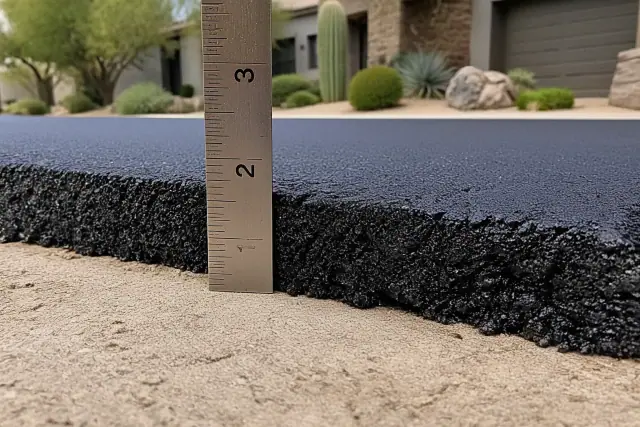
A fresh asphalt mat with the compacted depth being checked after rolling. The visual should make clear that overlay thickness is measured after compaction, not from loose material.
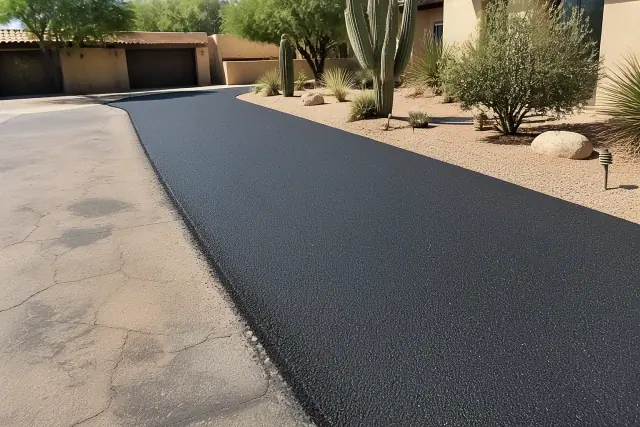
A passenger-car driveway beside a commercial parking lane or loading area. The comparison helps explain why 2 inches may suit a driveway while heavier traffic can need more structure.
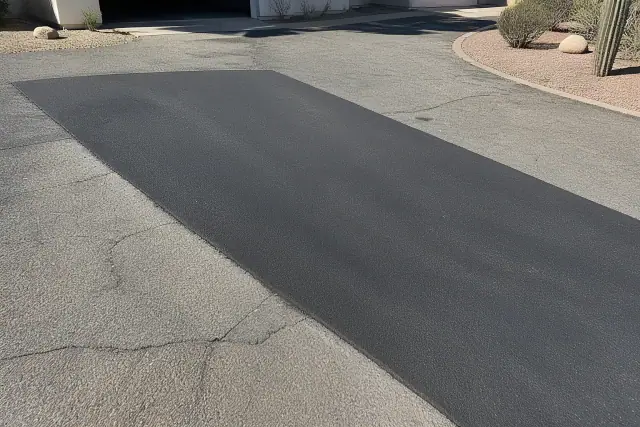
Cracking, potholes, standing water, or soft base symptoms before resurfacing. These are the warning signs that an overlay may mirror the same damage back through the new mat.
Confirm whether the existing base and sub-base are sound. Surface wear, fading, and minor cracking can fit an overlay, but structural distress changes the scope.
Traffic volume, drainage, aggregate base quality, Arizona heat exposure, and native soil conditions all affect the final overlay depth.
Move beyond a light overlay for RVs, boats, delivery trucks, loading zones, poor drainage, or a surface that needs a leveling binder course before the wearing course.
Do not place a thin new mat over a broken base. In Scottsdale heat, old cracks can telegraph through within a season or two when the underlying structure is not corrected.
| Surface or Use | Overlay Thickness | Full-Depth Reference |
|---|---|---|
| Residential driveway, cars only | 1.5 to 2 inches | 3 to 4 inches |
| Residential driveway with RVs or boats | 2 to 2.5 inches | 4 inches |
| Standard commercial parking lot | 2 to 3 inches | 4 to 5 inches |
| Heavy lanes or loading docks | 3 to 4 inches | 5 to 6 inches |
| Private access roads | 2.5 to 3 inches | 4 to 6 inches |
Overlay thickness is the compacted depth of hot-mix asphalt placed over existing pavement after rolling. On most overlay jobs, the new material replaces or strengthens the wearing course; if the surface is uneven, a leveling binder lift may be needed before the final course.
Cost should be weighed against structure: Scottsdale overlays generally run $2 to $5 per square foot, while full-depth replacement runs $5 to $12 per square foot depending on demolition, base repair, and thickness. Labor typically makes up roughly half of overlay cost, and smaller residential driveways can carry a higher per-foot rate than larger commercial lots because equipment mobilization is spread over less area. A cheaper overlay is not a good value if drainage, base failure, or potholes will bring the same distress back through the surface.
Common follow-ups are whether 2 inches is enough, when 3 inches makes sense, and when overlay should be skipped. For passenger vehicles over a solid base, 2 inches (about 51mm) can work well; full-depth residential replacement is closer to 3 inches (about 76mm) to 4 inches (about 102mm) over 4 to 6 inches of compacted aggregate base. The extra inch can make sense over a 20-year service life when RVs, boats, trailers, or poorly draining native soil raise rutting and cracking risk.
Send details about the driveway or parking lot, including traffic type, visible cracking, drainage issues, and whether the base feels soft. Scottsdale Asphalt can compare overlay versus full-depth paving before you approve the scope.